Should you make a career out of your autistic special interest?

Greg Fuqua, Mona Kay, and Scot Simpson recently had a conversation on the Neurodivergent Connections podcast about Autistic special interests and Monotropism and I wanted to share my thoughts.

Greg was very brave to share his story about how he wanted to turn his art special interest into a job and that it ultimately lead to failure, suicidality, and a deep depression. I think everyone should hear it and learn from it and take it as a cautionary tale.

He concluded that due to the high risk of failure, a person’s special interest shouldn’t be their work.

I disagree. Here’s why.

I had a very successful career at Google for 13 years doing my special interests of art and web development. I came in as an intern but I had more expertise and skill in web development than most of my peers. This is because I had spent significantly more of my free time creating, learning, and building websites compared to my peers because I was so fixated on it. And my weird combo of knowing both art and web design gave me a competitive advantage which landed me the job.

I’ve since left Google to build my own business, PaperDemon.com. I have the privilege of being able to combine my special interests of art, gaming, and web development into building something niche for the neurodiverse community.

It’s stressful not making an income right now. I wont lie. There are many days where I ask myself if I should give it up and go back to a corporate job. But I love it, I have a clear path forward to profitability, I am confident I will succeed, and I know my autism offers me a huge competitive advantage. Most businesses fail because people give up. Most people can’t tolerate failure or persist toward a goal as much as I can. And I owe a lot of that to my autism.

Am I a work-a-holic? Most people would say yes.

Is that a bad thing? For me, I think not.

I love my work. When I create, I feel a great sense of accomplishment, and I believe I am fulfilling my life’s purpose and using my unique gifts to make the world a better place. Not only did I make a great living doing it, it also gave me confidence early in my career that I desperately needed as a person with very low self-esteem.

Just because there’s a chance you’ll fail, doesn’t mean it isn’t worth pursuing.

The real lessons are:

Failure is the price you pay for success.

Learn to expect and accept failure. Failure is a great teacher. Learn to overcome perfectionism, and that persistence and practice will eventually lead to success.

Did my passion for my business create conflict in my marriage? Yes. But I did all the things Mona recommended in the video and it still didn’t work.

I was 100% transparent about everything, we set a budget, and every year I came in at or very close to budget, most years I was under budget. But my partner ended up resenting me anyway because I could not meet his unrealistic expectations. (There were a multitude of other problems too)

I am now happily divorced. My relationship with my work is my relationship with my self and it is sacred. If my partner does not understand or support my work, especially after I’ve objectively proven myself to be very capable of succeeding, then they are not the right partner for me.

Also I agree with Scott’s perspective. I really wish I had known about my autism much sooner. I would have reached self acceptance earlier and not tried so hard to be what everyone else wanted me to be.

Great conversation and thank you for posting this Neurodivergent Connections! Watch the video “When Autistic Special Interests Help, and When They Hurt – Monotropism IRL“.
Too sensitive

Today, I got really upset over the way a couple of people spoke to me in a business and programming related discord text chat. They were being critical of choices I had said I made. It was something trivial but still upset me.

And it upset me so much I was on and off crying the whole day, unable to get control of my emotions.

I decided to stick up for myself and state in the chat that the things that were said made me feel stupid and unwelcome. And I asked that people try to be a little kinder. My hope in advocating for myself would be that I might be able to sway this particular chat vibe to being more supportive and hopefully make it more welcoming for others.

And not surprisingly someone basically said I was being too sensitive and the fact I took it the way I did was my problem.

My rejection sensitive disphoria was already triggered before that comment but to not be seen and be shamed for being hurt, felt like being kicked while I was down. It brought back memories of being bullied as a child, crying, then being bullied some more for being a cry baby.

Thankfully someone jumped into the chat and said they could see how what was said could cause me to feel attacked. I felt seen. And it diffused the conversation.

But the damage was still done and my emotions continued to take me on a rollercoaster, a passenger watching it unfold. Knowing that my reaction was not rational didn’t help me.

I lost precious hours of what was supposed to be a productive day working on my business.

I tried many tricks to try and snap myself out of it. I went for walks. I tried to work. I tried eating. I used the usual CBT strategies to put the situation in perspective. I talked to myself the way a wise friend would. “You are sensitive because you had a traumatic childhood. And this person doesn’t know or understand that context.” ” You are hurting and that’s ok. Don’t fight it and let it out. This too shall pass.” “They didn’t mean to be hurtful. They’re trying to be constructive.”

The final thing that seemed to work was curl up on my bed in the fetal position and meditate for 45 minutes.

I wish I didn’t have RSD. The tough thing about it is not only does it cause me to overreact, but then I feel bad for overreacting. I understand that having it is just a result of ADHD and childhood trauma. But when I get upset over something someone says to me, and advocate for myself to say, hey that could have been said nicer, I’m inevitably going to be told or treated like I’m being too sensitive.

A good friend of mine often spoke critically of me and my business choices even after I would tell him in the moment how hurtful it was. Yet he continued to do it. And told me I was too sensitive and have poor self esteem and had no reason to feel so badly about myself. I made the tough decision to cut that person out of my life because it was clear they weren’t willing to meet me part way or be considerate of my feelings.

I have accomplished much in my life. I have had my art viewed by millions of people on the internet’s most popular web page, the Google homepage. I’ve successfully lead a team of engineers having a great tech career. And now I run a business where I get to make a difference helping neurodivergent teens and adults find belonging and confidence.

And those things help build my confidence and give me purpose and meaning in my life. But they don’t erase the childhood trauma.

I’d love to be able to say to myself, this discord conversation is trivial and doesn’t matter, so this pain shouldn’t be here. But all the same the pain is there. Like a reopening of an old wound. And I bear the pain once more for the whole day. Completely knowing the pain I feel is irrational. But not having much ability to stop it.

I understand that I must accept that this is part of who I am. And that there’s little I can do to change it. But I also have hope that some day I won’t be so sensitive and not be bothered by the words of others.

Update Nov 2, 2021:

After some reflection, I now suspect the reason I reacted as strongly as I did may have been caused by good ol’ pregnancy hormones. I am sensitive but to have reacted this strongly for this long still feels out of character for me.

On the bright side, having a poor experience in that server motivated me to find something better. I ended up finding two really great business discord servers with really nice and knowledgeable business people and am loving it so far.

One door closes, another one opens.

I was recently interviewed about Art RPGs and ADHD

If you’ve known me long enough, you probably know I have ADHD (Attention Deficit Hyper Activity Disorder). My ADHD has made my life a challenge in many ways, and one of which is motivation.

This is one of the reasons I am so passionate about gamifying art and supporting the Art RPG community. I see Art RPGs as a fun way to help motivate neurodivergent artists to get past their perfectionism and motivational challenges and get creating again by bribing them with virtual gold, XP, and more.

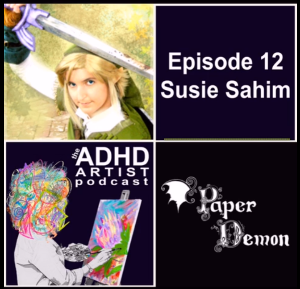
Recently, I was invited to be interviewed on the ADHD Artist Podcast to talk all about Art RPGs and how they can benefit the ADHD artist community.

I had a lot of fun chatting with the host, Sarah Guise. We talked about Google doodles, disclosing your disability at school and in the workplace, PaperDemon, and Art RPGs. Actually there’s a TON more that I feel like we could have talked about. I hope I get the chance to come on again because ADHD is one of those topics that I have passionate opinions on.

ADHD Artist Podcast Episode 12

Listen to the interview

And if you’re an artist with ADHD, check out the other episodes available on their podcast, too!